Newfarmer Notes
Last updated - November, 2009
We are very fortunate to have had John Reeb, a researcher involved
in the Keskastel region of France, discover our website. Keskastel,
Bas-Rhin, France is located between what was Alsace and Lorraine
in the eastern part of France near the German border and was part of
Germany until the French acquired it during the Napoleonic era.
John has been doing genealogy for about 25 years, and in 1988 visited
the Keskastel area to look for records of his Reeb ancestors and other
families that might be related. In July of this year, John recognized a
Neubauer family from Keskastel who seemed an exact match for our
Newfarmer family and made contact. Essentially, John was working
down from the Keskastel Neubauers, we were working upward from
our Newfarmers, and we met at the Henry Newfarmer family in Ohio.
John has added two more generations to our knowledge of Newfarmer
ancestors, and has identified the Newfarmer homeland in France.
He has also added some cultural knowledge to some of the issues
around the Newfarmer genealogy which will show up in the narrative below.
A colleague of John's, Pam Maurer Pruiett, also engaged in our discussion
and added more information to the trove.
Unfortunately, we still haven't found a documented link with the "other
Newfarmer family", but we seem closer than before. More on that later.
Newfarmer Family History - The First Newfarmers
There are two families of original Newfarmers in America, one found
in Ohio, and one in Indiana. We previously were almost certain that
the original immigrants were Henry and John Newbauer, listed in the
Erie County, Pennsylvania naturalization records as arriving in 1850
in Philadelphia. Henry's listed year of birth is 1825, which matches
closely with later census data, and John Jr.'s is 1817. Both are listed
as coming from Darmstadt, Germany. After corresponding with the
Erie Genealogical Society, it appears that these two Newbauers
stayed in Erie, Pennsylvania and retained their name Neubauer.
Henry (groceries and produce) and John (bookkeeper) Neubauer
are found in the 1877 Erie City Directory living at the same address.
Although there are minor discrepancies, Henry and John can be found
in Erie, Pennsylvania in the 1880 census, still engaged in the grocery
and allied business. They were city folks, while our Henry was a farmer,
and we now believe that these Neubauers were not connected with
our Newfarmers.
If these are not the original Newfarmers, it resolves certain inconsistencies
in the data. The naturalization records say that the two emigrated from
Darmstadt in 1850. Henry Sr., his probable mother Catherine, and Henry Jr.
all say they were born in France, and Darmstadt is some distance from the
French border. Also, Henry Sr. reports in the 1900 census that he arrived
in the U.S. in 1848 and had lived in the U.S. for 52 years. It is clear from
census pages that Henry was living in Ohio from 1860 to 1900, not in Erie,
Pennsylvania.
We recently came across an on-line database, the Ohio Death Index,
1907-1944, which, along with William, Frederic, and Oakley Newfarmer,
holds records for Henry Newfarmer (d. 1914), John Neibauer (d. 1914),
and William Neibuhr (d. 1921). We sent for copies of these death
certificates, and unfortunately, none hold any new information. Henry Sr.'s
death certificate was filled out by his son William, and William did not know
his grandfather or grandmother's names.
At this point, where we have been stuck for the past six years, it is appropriate
to introduce John Reeb's research. The records he obtained from Keskastel,
France, show that George Friedrich Neubauer (1781 - 1848) and his wife Maria
had ten children, the first two of which were the sisters Christina Margaretha
and Catherine. Christina married Michael Maurer, which will become important
later in the narrative. Catherine was the mother of our Henry Newfarmer (Heinrich
Neubauer) and three other children, all born out of wedlock according to the
church baptismal records. The children were given the surname of their mother
and the father's name is unknown. The cultural wisdom John Reeb gained
during his trip to France helps here. During the time Catherine was having
children, there was a significant marriage tax in France, and often young couples
couldn't afford to pay it, therefore they could not be legally married. The church
overlooked this technicality and baptized the children, but recorded the children
as born out of wedlock and bearing the mother's surname. So, we don't really
have an illegitimate family. Our Henry was probably caught up in the same issue,
so when Henry, his semi-wife and child emigrated to the U.S., they immediately
married in Ohio.
When time permits (soon) we will upload the entire descendancy of
George Friedrich Neubauer, with the new data obtained from John
Reeb and Pamela Pruiett, so we won't go into the rest of the family
detail here.
We have accumulated a lot of information on the Newfarmers, and
will summarize our findings, first with Henry and then with John. All
of the source documents used in this history, as well as the traditional
genealogy charts and lists, are in the Newfarmer Family Research
Papers in the possession of Shirley Pace Newfarmer. We appreciate
the addition of copies of source documents on the Keskastel Neubauer
and Maurer families from John Reeb and Pamela Pruiett, and these
will be provided to the Newfarmer family as soon as we have them
all collected.
John Reeb's records show that Henry Newfarmer (Heinrich Neubauer)
was born on August 11, 1828, in Keskastel, France. He came to America
in 1848 from Le Havre, France aboard the ship ADMIRAL along with his
wife Christina and presumably his son Henry Jr., who was not listed on
the ship's manifest, probably because he was a baby. This was before
the use of steam engines on transatlanic ships so the ship would have
been entirely sail. Voyages took from 20 to 60 days and the ships were
small by today's standards, 160 ft. long by 35 ft. wide, and it must have
been a difficult voyage.
Henry arrived in Ohio in 1848 and was officially married to his
wife Christina Schwab in Franklin County, Ohio on 19 Feb 1849.
We first find Henry in the census records in the 1860 census
for Logan County, Ohio, near the town of DeGraff. He is
32 years old, living with his wife Christina Swolp Newfarmer
and their seven children. Also living with Henry is Catherine
Newfarmer, 58, proven by John Reeb's records to be his
mother. He is listed as a farmer, born in France. Also listed
as being born in France are his wife, first son Henry Jr., and
mother Catherine. In later census documents, both Henry and
his children waver between whether he was born in France or
Germany, but we now know that he was born in France.
Between 1860 and 1870, Henry's wife Christina had at least
three more children, and died in childbirth in 1867 at age 40.
As was common practice in those days, all the children were
distributed among friends or church members. Farmers weren't
equipped to deal with children and still maintain their livelihood,
and there were no elder daughters to take over. Henry remarried
in about a year to Henrietta Hines, a widow born in Pennsylvania,
and they relocated to Champaign County (a short distance from
DeGraff, over the Logan County border) and had three more
children. There is no evidence that Henry's eight living children
from his first marriage ever visited their father, and in fact the
evidence shows that there was probably great animosity over
the death of the mother and the breaking up of the family. Henry's
mother Catherine took daughter Magdalena, and possibly Mary
and Jacob, and moved to Randolph County, Indiana, to live with
the Maurer family. From John Reeb and Pamela Maurer Pruiett
(descendent of the Maurer family), we now know that Christena
Maurer was Catherine's sister. The rest of the family scattered.
Tracing the children of Henry and Christina, in order of birth, after
Christina's death:
- Henry Jr., born 1848 in France, was found in the 1870 census,
age 22 and single, still living around DeGraff, Ohio, and working
as a farm laborer on the farm of Milton Wolfe. After 1870 he dis
appears from the records and is not to be found again.
- Frederick, born 1850 in Ohio, also stays in the vicinity of DeGraff
working as a farm laborer in the 1870 census on the farm of Margaret
Spence. In the 1880 census he can be found working as a laborer,
still in DeGraff. He shows up again as a bachelor living with his brother
William and William's family in DeGraff in the 1900, 1910, and 1920
census. It appears that Frederick never married. He died in 1937.
- Solomon, born 1852 in Ohio, like his older brothers is found as a
farm laborer in the 1870 census, working on the farm of Samuel Koegler
in Logan County. He stays in Logan County where he marries Sarah
Elizabeth Line in 1881, and has one child, Phinton R. Newfarmer, born in
Logan County, Ohio, in 1881. Solomon is last found in the 1900 census
listed as having one child, none living. So, we can assume Phinton died
before age 19, and Solomon had no more children.
- Mary, born 1851 in Ohio, probably went with her grandmother Catherine
to Indiana after her family was broken up. She married in 1874 to Lewis
Klamberg in Randolph County, Indiana. In 1898 she married George Yeager,
and when she is found with him in Randolph County, Indiana, they have her
son William Klamberg and daughters Amelia and Adelia Klamberg with them.
At this point she says she has had seven children, six living. In the 1910
census of Madison County, Indiana, taken in April, 1910, she is living alone
and says she had four children, one living. In August, 1910 she married
Abraham Whelchel in Madison County, Indiana, and we have not yet found
her in 1920. It's probably appropriate to note here a number of names from
Indiana that come up again when we visit the descendants of John Newfarmer.
The surnames Kepner, Whelchel, and Pettigrew consistently come up as being
associated with both the families of Henry and John, and establish another
probable link between the two brothers (or possibly cousins).
- Jacob, born either 1852 or 1855 (his age in the census is not consistent) is
found in the 1870 census in Green County, Ohio, single, age 15, also working
as a farm laborer. After that, he disappears from the records. The History of
Madison County, Illinois, in its biography of George Washington Pettigrew, lists
the living children of George's father Samuel Pettigrew including a Mary E., widow
of Jacob Newfarmer. So we now know that Jacob married Libbie Pettigrew
(see the section on Libbie later) in Indiana, and died sometime before the book's
publication date of 1914. They had three daughters.
- Magdalena, born 1857, was taken by her grandmother Catherine to Randolph
County, Indiana. In all probability, Magdalena (also called Lena) suffered some
birth defect or retardation, since she lived with her grandmother until her
grandmother's death, and then was committed to a hospital for the insane where
she lived from about 1910 until after 1920. She probably did not have children,
although one census lists her as having one child, none living.
- William, born 1859, Ohio, lived out his life near DeGraff, Ohio, marrying
Lou Belle Able in 1886 in Logan County, Ohio. He had one male child,
Oklahoma Newfarmer (also called Okley and O.K.) born in 1888. Oklahoma
died in 1915 at the age of 27 and there is no record of his marrying or having
children. William died in 1933 in Logan County, Ohio.
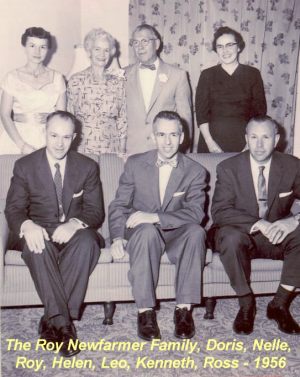
- Samuel, born 1862 in Ohio, is the father of Roy and Ray
Newfarmer. He shows up on no census in 1870 or 1880,
but his youth can be reasonably chronicled from family history.
Samuel lived during the latter part of his life with his son Roy
in Colorado and likely commented on his youth. Excerpts from
notes written by Roy and later Newfarmers show that Samuel,
like his siblings, was sent off to live with another family when his
mother died in 1867. Samuel would have been five years old.
Comments from the Newfarmer documents are:
"...he (Samuel) was apprenticed as a blacksmith, but his master
worked him night and day, and whipped him, so Sam ran away
and lived with another family, where he learned to become a blacksmith."
"Samuel worked as a blacksmith in Philadelphia, and later owned
a blacksmith shop in Montrose, Colorado from about 1919 to 1923."
(I've misplaced or returned the source document, but this is close)
"Samuel was apprenticed out at age 12 as a blacksmith, and was
so upset at being sent away that he never spoke to his father again."
In 1870, Samuel would have been eight years old, and likely had
lived with his second family for three years. He would have been
apprenticed out in 1874 as a blacksmith with another family, spent
several years suffering, and then ran away to Philadelphia where
he either apprenticed or worked in the shipyards. It would not be
surprising for the census takers to miss him there in 1880, and in
any case, he may have been using some other surname than Newfarmer.
By 1887 Samuel had traveled to Randolph County, Indiana, probably
to visit his relatives, and married there to Emma Allen on August 6, 1887.
He shows up in the 1900 census for Randolph County, Indiana, as a
blacksmith, with his wife and two sons, Roy - age 11, and Ray - age 9.
From there, we have a complete history of his family.
- David, born 1856, and Emma, born 1867, both died at about two
months old. Both are buried in the Greenwood Cemetery in Logan
County, Ohio, along with their mother Christina, William and his wife
Lou Belle and child Oklahoma. Emma's age and date of death are
particularly significant, in that they calculate to a birth date exactly the
date that Christina died.
That accounts for all of Henry's children by his first wife, and with the
exception of Samuel, it appears that none of Henry's male children
had male offspring who lived to have other Newfarmers. Henry's
second marriage resulted in two female children and two sons.
Edward had one daughter, and Walter had one daughter, so no
new Newfarmers there either. Thus, any existing Newfarmers from
Henry's line are through Roy Newfarmer, and we can account for all
of them (the other Newfarmer son Ray died in WWI at age 30 in
France and is buried there). Which leads us to the more speculative
issue of "the other Newfarmers."
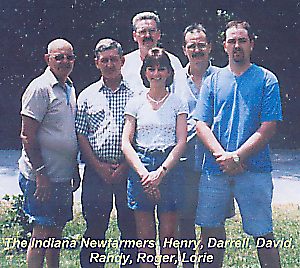 Newfarmer is not a common name in the U.S. It appears that most
of the immigrant Neubauers and the like kept their German name.
There are hundreds of Neubauers, Newbauers, Neibuhrs, and
Neibauers in the U.S. A search of all of the phone directories
in the U.S. shows only 20 Newfarmer names, and most can be
accounted for by Roy's descendants. In 1984-85, Ross Newfarmer
discovered the "other Newfarmers" when he answered an ad for a
"Newfarmer Family Heritage Book." The resulting list of Newfarmers
included an unknown James D. Newfarmer of Bourbonnais, Illinois.
Ross' nephew Don began a correspondence with (James) David Newfarmer
which resulted in some conflicting information from David, but a complete
listing of his siblings and their children, and enough facts to establish the
family ancestry.
Newfarmer is not a common name in the U.S. It appears that most
of the immigrant Neubauers and the like kept their German name.
There are hundreds of Neubauers, Newbauers, Neibuhrs, and
Neibauers in the U.S. A search of all of the phone directories
in the U.S. shows only 20 Newfarmer names, and most can be
accounted for by Roy's descendants. In 1984-85, Ross Newfarmer
discovered the "other Newfarmers" when he answered an ad for a
"Newfarmer Family Heritage Book." The resulting list of Newfarmers
included an unknown James D. Newfarmer of Bourbonnais, Illinois.
Ross' nephew Don began a correspondence with (James) David Newfarmer
which resulted in some conflicting information from David, but a complete
listing of his siblings and their children, and enough facts to establish the
family ancestry.
The inconsistencies in the information provided by David can be accounted
for by the fact that like Henry's children, David's ancestral twins, Henry and
William, were orphaned at age 5, and hardly knew their true parents. However,
we can piece together the probable ancestry of these Newfarmers.
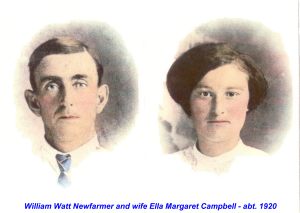 It is undisputed that there were twin boys, Henry Otto Newfarmer and William
Watt Newfarmer, born in 1875 to William Newfarmer and Jane Kepner.
William Newfarmer was born in Indiana or Ohio, most likely the son of
John Newfarmer and Barbara Kepner. It was very common for pioneer
families to stick together and intermarry for generations, and the Newfarmer,
Pettigrew, Kepner, and Whelchel families can be found together from 1850
forward. David Newfarmer sent for his father's death certificate, which
attests to his parentage. Henry Otto Newfarmer is not accounted for after
age 24, but William Watt Newfarmer is easily found. Both twins can be
found in their early years. There is a solvable mystery which surrounds
their parentage, and takes a few facts to get started:
It is undisputed that there were twin boys, Henry Otto Newfarmer and William
Watt Newfarmer, born in 1875 to William Newfarmer and Jane Kepner.
William Newfarmer was born in Indiana or Ohio, most likely the son of
John Newfarmer and Barbara Kepner. It was very common for pioneer
families to stick together and intermarry for generations, and the Newfarmer,
Pettigrew, Kepner, and Whelchel families can be found together from 1850
forward. David Newfarmer sent for his father's death certificate, which
attests to his parentage. Henry Otto Newfarmer is not accounted for after
age 24, but William Watt Newfarmer is easily found. Both twins can be
found in their early years. There is a solvable mystery which surrounds
their parentage, and takes a few facts to get started:
- Marriage records for Randolph County, Indiana, show that Elizabeth
Jane Kepner married George Washington Pettigrew in September, 1869.
George was previously married to Elizabeth Davis Williams and had five
children with her. Elizabeth Jane Kepner was the daughter of William and
Elizabeth Kepner.
Note - I recently received the following, along with much
information on the Pettigrew line, from Teresa Pettigrew in Indiana:
"George then married Elizabeth Jane Kepner 9-30-1869 in Hamilton County,
Indiana. Probably to help care for his children. She is back in her father's
household on the 1870 census. She has a son, Cordie L. Pettigrew born
in 1871. He died when he was three and is buried in the Kinnaman
Cemetery, Hamilton County, Indiana. We found a divorce record for
George and Elizabeth in Hamilton County in 1872. Custody of the child
given to Elizabeth's father. We don't know what this situation was or why
she left George. My theory was that the child was not George's. And that
she did not want to care for step-children. Maybe she was forced to marry
him. We want to get back into the court records and see if it tells why they
divorced. She marries Levi L. Whelchel 2-14-1882 in Hamilton County,
Indiana. George marries a third time to Sarah Elizabeth Whelchel 6-4-1880
in Hancock County, Indiana. They are on the 1880 census in George's daughter's
household. With them is her son James Valentine from her first marriage.
They have one child, Mary Magadeline 10-6-1881. George dies 12-27-1882
and is buried at Beech Grove Church Cemetery, Pendleton, Indiana, next to
his father and mother. Sarah Elizabeth marries a third time to Peter Bolander
3-18- 1886 in Hancock County, Indiana. They have two children, Boss and Fairy.
Sarah Elizabeth died in 1916 and is buried in the Beech Grove Cemetery.
This is my cousin Martha's line. She has given me a lot of info, and she has
been doing genealogy for 50 years. She has been on the Madison County
Cemetery Society, and is a member of DAR. (Daughters of the American
Revolution). Most of what I have told you is documented. We have copies
of a lot of records."
- In the 1870 census, taken in July, Elizabeth Pettigrew (20) is found
back with her parents, William and Elizabeth Kepner, in Hamilton County,
Indiana, just a year after marrying George Pettigrew. George is nowhere
to be found. Living with this family is a William Kepner listed at the end - a
listing like this means that William is not an immediate member of the family.
In the 1850 census, Elizabeth Jane is the oldest child, which further confirms
that William, age 24, is not a member of William and Elizabeth Kepner's family.
Pure speculation, but could this really be William Newfarmer? It's not uncommon
for an individual to assume the name of the people he's living with, particularly in
this case, if his father was John Newfarmer and his mother Barbara Kepner; and
two individuals aged 24 and 20 and living in the same house would certainly set
up a relationship that could have resulted in the twins, Henry and William. An
interesting addition to the record is that in the 1870 census, young William Kepner
(or is it Newfarmer) reports that he was born in Indiana. In the recently released
1930 census, William Watt Newfarmer reports that his father was born in Indiana,
so there is no inconsistency there.
- In 1875, the twins, Henry and William, are born to Elizabeth Jane Kepner
and William Newfarmer. No birth record for the twins, or marriage record of Jane
and William can be found, but the death record of William Watt Newfarmer, obtained
by David Newfarmer, lists his parents as William Newfarmer and Jane Kpner.
- In the 1880 census, William and Henry Newfarmer, both 5 years old, are
found with their mother Elizabeth J., living with William and Elizabeth Kepner in
Hancock County, Indiana. In the same census, just down the road in Madison
County, Indiana, George Pettigrew and Elizabeth Whelchel are living with one
of George's daughters by his first marriage. William Newfarmer is nowhere to
be found.
- Elizabeth J. Pettigrew then marries Levi L. Whelchel in February, 1882,
and they move to Illinois. George Pettigrew dies later in 1882.
- In the 1900 census, Elizabeth and Levi Whelchel are found with their
three children, and just down the street are Wat and Ott Whelchel, both born
1875 (24 years old and single), living with the William and Alta Grace family.
The twins full names were William Watt Newfarmer and Henry Otto Newfarmer,
so Wat and Ott are obviously the twins. Alta Grace is Levi and Elizabeth's
daughter, so that fits also.
- The 1910 census finds William Newfarmer, now 35 years old, still
living with Levi and Elizabeth Whelchel in Jackson County, Illinois. In his
correspondence, David Newfarmer says his grandfather didn't get married
until he was 42 years old, so this also fits. The other twin, Henry Otto
Newfarmer, is not to be found.
- In the 1930 census William Watt Newfarmer is found with his
family, reported as Wat Newfarmer, which further solidifies the naming
conventions.
So those are the facts. We know that William Watt Newfarmer married
Ella Margaret Campbell and had four children, including two boys. The
"other Newfarmers" can all be traced to this family. So, it appears that
the elder Henry Otto Newfarmer had no children.
As a recent aside, Elizabeth may have had an additional relationship
besides George Pettigrew, William Newfarmer, and Levi Whelchel.
The census page I sent to a Newfarmer showing the twins in 1880,
both age 5, also showed a Dora Guynn, age 3, listed just below the
twins. Randy Newfarmer wrote back:
"I wanted to draw your attention to one of the census sheets you sent
us. It is page #30, or your page #6. Listed under Henry Newfarmer
is Dora Guynn. This is one of Grandpa's half-sisters that I was telling
you about. I don't know if she was married to the Guynn, or had a child
out of wedlock. And I don't know if Dora was her only child by the Guynn.
I talked to Dora's granddaughter last week and again Monday night, and
they are trying to piece together what information they can gather. Will
share it with you as soon as we have it. She is buried at the Crain
Cemetery, where our great grandmother Elizabeth is apparently buried. "
Our speculation that William Newfarmer, father of the twins, was the
son of John Newfarmer and Barbara Kepner, comes from the
vascillations of David Newfarmer as to who were the parents of
the twins. His information comes from his aunt Beulah, and goes
back and forth over time between William-Jane and John-Barbara.
Chances are the confusion results from William-Jane being the
parents and John-Barbara being the grandparents. This needs
further study.
The interesting part of this family's history is the close relationship
with the same locations and surnames as Henry's first family. When
Henry's first wife died, his mother and some of his children relocated
to Randolph County, Indiana, the same location where George Pettigrew
married Elizabeth Jane Kepner and probably where William Newfarmer
settled. Henry's daughter Mary's third marriage was to Abraham Whelchel
in Madison County, Indiana, and her first and second marriages were in
Randolph County. Samuel's marriage was in Randolph County, Indiana.
Elizabeth Pettigrew married Jacob Newfarmer in Indiana. I think that the
strong link between the two Newfarmer families is through Catherine,
Henry's mother.
It should be noted that in John Reeb's records there is not any individual
that would compute to be William Watt Newfarmer's father or grandfather,
and there is always the possibility that there is another Neubauer that is
his ancestor. Of the surnames that associate with the William Newfarmer
family, none have been associated with Henry's line. And, the likely
candidate, Catherine's brother Johann Nicolas Neubauer, spent his life
in Franklin County, Ohio, and was never seen in Randolph County, Indiana.
So, much work is left to do here.
A most intriguing individual is Libbie Newfarmer, shown in the census for
Madison County, Indiana, taken in June, 1880. Originally we speculated
that Libbie, based on the information in the census, was probably married
to Henry's son Jacob Newfarmer. From a recent posting to the Internet, we
have confirmed that Jacob Newfarmer was the husband of Libbie. In "The
History of Madison County, Indiana, published in 1914, a biography of George
Washington Pettigrew (not our George - there were three of them in the family)
there is a listing of the living children of George's father Samuel Pettigrew.
Among these are a "Mary E., widow of Jacob Newfarmer." Mary E. would be
Mary Elizabeth "Libbie" Pettigrew Newfarmer, and she would be the niece of
the George Washington Pettigrew Jr. who was the first husband of Elizabeth
Jane Kepner, the mother of the Indiana Newfarmer twins. So we have
established both the Indiana and Ohio Newfarmers marrying into the same
Pettigrew family. While not conclusive evidence, with the other circumstances
stated earlier, it would seem almost certain that the family of Catherine
Neubaure (Newfarmer) and her sister Christina Neubauer Mourer is related
to the William Newfarmer clan.
That's about where we stand. We have a number of inquiries out that may
solve some of the issues and add to the genealogy file, and it often happens
that posting the ancestors to the Internet will smoke out some relatives with
information. We'll keep the file updated.
Jim Pearce

